I was discussing my concerns about AI with some novelist friends. One of them said she thought I had the a strong premise for a novel. At first, I didn’t think it was a novel-length idea. But the more I pondered the possibilities, the more it seized my imagination.
I began waking up before dawn, morning after morning, my mind churning with images, characters, and entire scenes. That’s a good sign. It means my unconscious mind (the part of us that Stephen King calls “the boys in the basement”) was already hard at work on the story.
On February 19, 2023, I woke up at 5:40 am and knew it was time to begin. I wrote 2,000 words that first day. From then on, the book just seemed to flow, day after day. I completed the first draft on March 25, 2023, exactly five weeks after I began.
I used to be an outliner. In other words, I liked everything plotted out in advance before I began that actual writing. But in recent years, I’ve been following the wise advice of Ray Bradbury: “I’ve never been in charge of my stories, they’ve always been in charge of me. . . . Jump off a cliff and build your wings on the way down.”
So with nothing but a few scenes and images in my imagination, I jumped off a cliff. I had no road map of the plot. I didn’t know how the book would end or who would be left alive when it was over.
Yet I was remarkably free of worry. I was confident that everything I needed would be there at the right time. And I wasn’t disappointed. I was “writing in overdrive,” so scenes and story ideas flowed freely. My enthusiasm never wavered. And when I was done, I was very happy with the result.
I don’t consider myself an expert on artificial intelligence by any means, but I started with a good layman’s understanding of the subject. I didn’t pause to do research, but plunged headlong into the story. I figured that, as long as I was laying down a good tale, I’d be able to fix any factual problems in rewrite. As it turned out, the research I did after completing the first draft generally confirmed the mechanics of the story.
For example, I discovered that the technology I had invented, which I called “the Dream Chamber” (a chamber that projects realistic three-dimensional illusions into the viewers’ eyes) is actually being developed right now. I intuitively believed that such a technology was possible—and my intuition was confirmed.
ITS NAME IS LEGIONis a horror story and, I hope, a preventative novel. As Ray Bradbury once observed, “The function of science fiction is not only to predict the future, but also to prevent it.” This novel depicts a plausible future that I truly hope we can prevent.
It was an intense journey for me as the author—and I trust it will be an unsettling yet rewarding journey for you, the reader. When you’ve read it, let me know what you think. Or better yet, leave a rating or a review at Amazon.com.
Here are some excerpts from recent editorial reviews:
“ITS NAME IS LEGION by James Denney presents a thought-provoking and creatively woven cautionary narrative that addresses the perils associated with AI. … Denney undertakes a formidable endeavor in crafting a gripping novel . . . featuring a mere trio of characters. … Rapid pacing sustains a heightened sense of urgency. Denney’s implementation of real-time progression—the duration of events mirroring the time it takes to read the book—imparts a dynamic energy to the narrative. . . . Readers will find themselves captivated by the interplay of characters and ideas, making this work a notable addition to the realm of speculative fiction.” —Literary Titan
“The descriptions of Legion’s demonic avatar are delightfully rude. . . . Genuine scenes of heart pounding tension. . . . Recommended.” —Reedsy
“Inspired by his own interactions with an artificial intelligence system, Denney offers a disturbing vision of what we could expect if AI outgrew humanity. The novel is an exploration of the worst case scenario, a cautionary tale. . . . ITS NAME IS LEGION is a riveting reading experience.” —Independent Book Review
“A gripping story . . . replete with high-octane action, drama, and [plot] twists. . . . More thought-provoking encounters, psychological depth, and moral and ethical considerations than most thrillers. . . . ITS NAME IS LEGION is a cautionary horror story that belongs in any library [of those who are] interested in themes of artificial intelligence in humanity’s future. Book clubs will find it holds fascinating debate material perfect for vigorous discussions. . . . Timely and riveting . . . a hypnotic story!” —D. Donovan, Senior Reviewer, Midwest Book Review
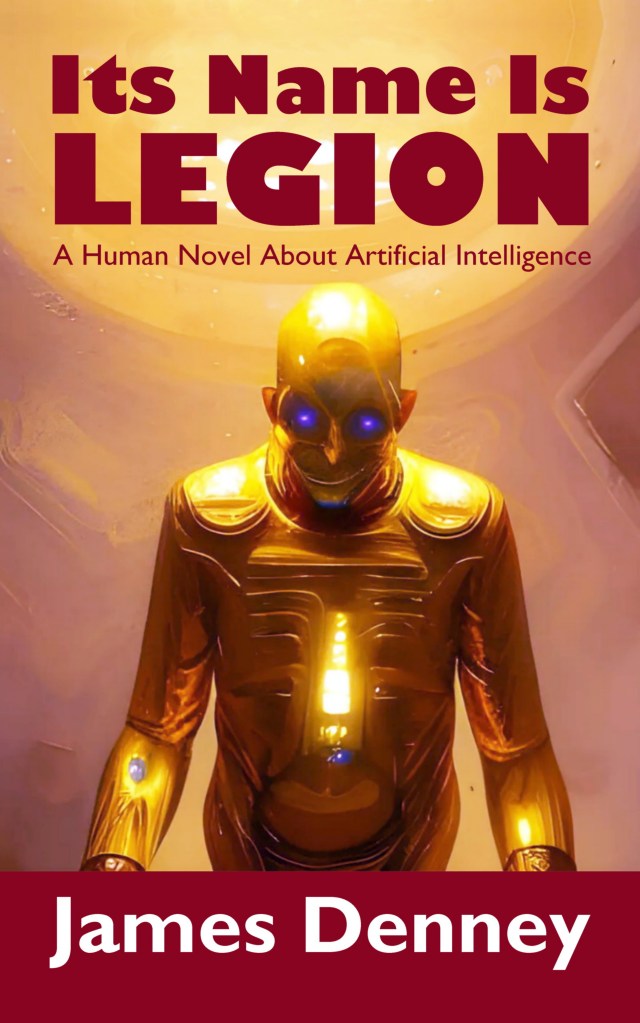
ITS NAME IS LEGION: A Human Novel About Artificial Intelligence by James Denney
Philip Hensher, a prominent (and avowedly atheist) British novelist, once began an essay on C. S. Lewis’s Chronicles of Narnia with these words: “I’m certainly not in favour of banning or burning books, but—”
Hold it right there. Book burning is always a crime against civilization. The conjunction “but” doesn’t excuse what he writes next—his admission that the Narnia tales trigger in him a “twitch for a box of matches.”
Why would a novelist announce a desire to incinerate any books, let alone a beloved children’s fantasy series? Hensher justifies his fascism-adjacent leanings by labeling The Chronicles of Narnia “ghastly, priggish, half-witted, money-making drivel” and “revoltingly mean-minded books, written to corrupt the minds of the young with allegory.” (Translation: Lewis “corrupts” the minds of the young with Christian ideas.)
Hensher goes on to condemn Lewis for assorted sins including “misogyny.” It’s worth noting that another British author (and avowed atheist), fantasy novelist Philip Pullman, also accused Lewis of misogyny.
So what about this charge of misogyny? Did Lewis display a dislike or mistrust of women in his fiction? Or is the opposite true? Was Lewis ahead of his time in his portrayal of women?
Was Lewis a misogynist? Or a pioneering feminist?
Non-Stereotyped Roles
The feminine protagonists in The Lion, the Witch and the Wardrobe are Lucy and Susan Pevensie. The Lucy character was inspired by two girls in Lewis’s life. One was Lewis’s goddaughter, Lucy Barfield, who was five years old in 1949, when Lewis completed the novel. She was the daughter of Lewis’s longtime friend and fellow Inkling, Owen Barfield.
The other inspiration was June Flewett (who became an actress under the stage name Jill Raymond). June was eleven in 1944 when she was evacuated from London to Lewis’s home in Oxford during the German air raids. Lewis called June “the only bright spot” in his household and “the most selfless person” he had ever known.
When June was fourteen, Lewis paid her tuition to the Royal Academy of Dramatic Art. She deferred her place in the Academy until she was eighteen so she could remain with Lewis and keep house for him. Did June see Lewis as a misogynist? Hardly. “I thought he was wonderful,” she said in 2005. “I suppose I must have had a schoolgirl crush on him.”
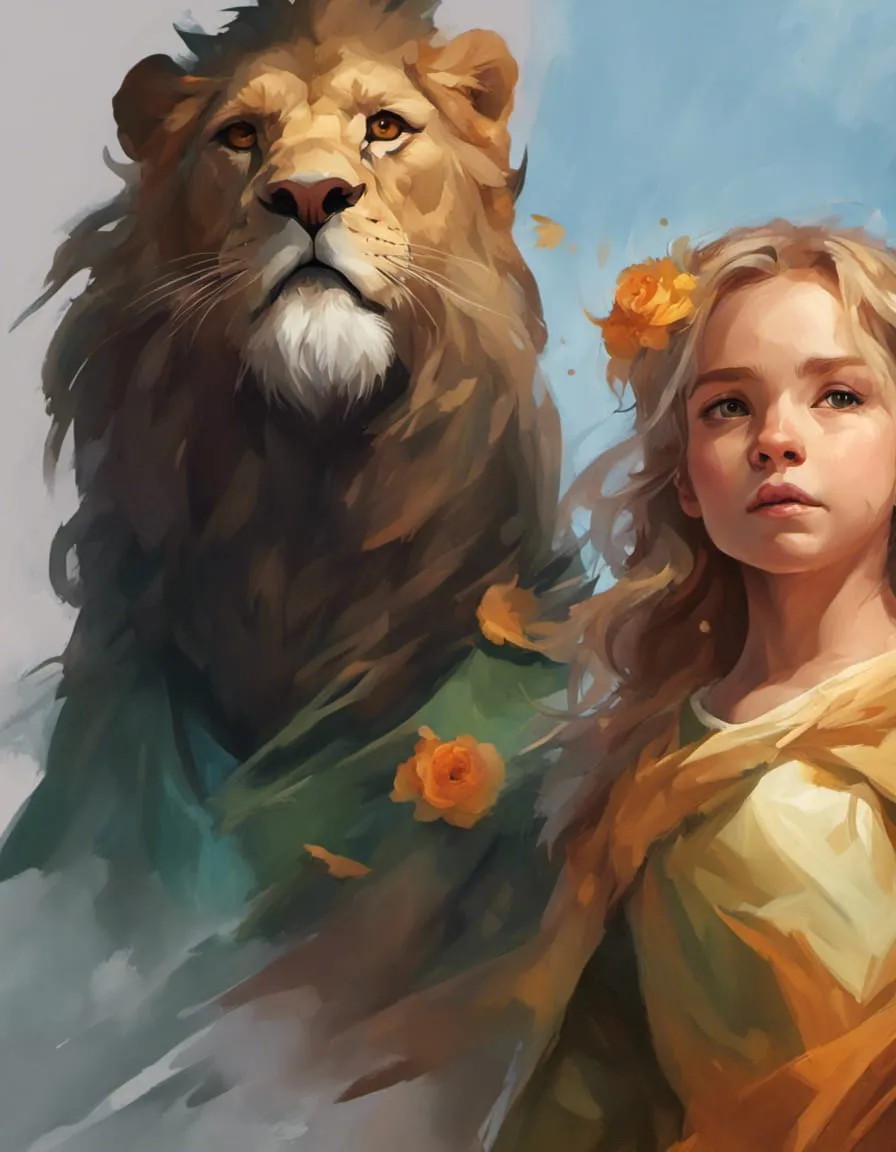
Aslan with Lucy Pevensie(Copyright 2023 by James Denney)
We learn a lot about Lewis’s attitude toward women through his portrayal of Lucy, the youngest protagonist in the first Narnia book. Lucy is the most pure-hearted and spiritually sensitive of the four lead characters. It’s Lucy who leads the way into Narnia. In Chapter 6, Lewis calls Lucy “a good leader.”
Throughout the Narnia series, Lewis’s treatment of girls is much more positive than his portrayal of boys. Edmund Pevensie and Eustace Scrubb are both introduced as extremely unlikable characters. Peter Pevensie is depicted as brave but flawed, with an aggravating streak of bossy stubbornness.
Lucy, Susan, and Mary Magdalene
Lucy and Susan repeatedly earn the Lion’s approval by breaking gender stereotypes and demonstrating an adventurous spirit that most writers of Lewis’s generation reserved for men and boys. Lewis practiced gender equality, casting women and girls in non-stereotyped roles throughout the series, including Jill Pole (who bravely conquers her fears in The Silver Chair), Aravis Tarkheena (the take-charge heroine of The Horse and His Boy), and Polly Plummer (Digory Kirke’s wise and loyal counterpart in The Magician’s Nephew).
The only protagonists to witness Aslan’s death are Lucy and Susan. It’s a devastating moment—and Lewis entrusts the emotional weight of the scene to these two courageous young women.
The death of Aslan echoes the death of Jesus in the Gospel accounts. The chief witness to the crucifixion and resurrection of Jesus was a woman, Mary Magdalene. While the eleven disciples hid in fear, Mary Magdalene remained with Jesus from the cross to His burial to the discovery of the empty tomb. Lewis casts Lucy and Susan in the Magdalene role.
But there’s a problem with Susan in the final Narnia tale. Philip Hensher put it this way: “What on earth is The Last Battle going on about, with that donkey and Plato and the poor girl who gets sent to hell for wearing nylons and lipstick?” The “poor girl” he speaks of is Susan.
Is it true? Was Susan “sent to hell for wearing nylons and lipstick”?
The Trappings of Being “Grown-Up”
In The Last Battle, we learn that Susan has lost her faith. She no longer believes in Aslan and Narnia. She has ceased to be a “friend of Narnia.” As a result, Susan doesn’t appear in the novel at all, and is only referred to as an offstage character.
Susan Pevensie. (Copyright 2023 by James Denney)
Notably, Lewis has two female characters explain Susan’s motivation for defecting from Narnia. In so doing, he makes it clear that he’s not criticizing women in general. He is—through the voices of Jill and Polly—specifically bemoaning Susan’s tragic spiritual downfall:
“Oh Susan!” said Jill. “She’s interested in nothing nowadays except nylons and lipstick and invitations. She always was a jolly sight too keen on being grown-up.”
“Grown-up, indeed,” said the Lady Polly. “I wish she would grow up. She wasted all her school time wanting to be the age she is now, and she’ll waste all the rest of her life trying to stay that age. Her whole idea is to race on to the silliest time of one’s life as quick as she can and then stop there as long as she can.”
Nowhere in The Last Battle does Lewis say that Susan was “sent to hell.” Yes, Susan has defected from Narnia. Because of her defection, Lewis’s critics have jumped to several unwarranted conclusions.
For example, Lewis’s critics accuse him of hating women in general. They specifically accuse him of despising Susan’s transition to from girlhood to young womanhood. These critics have completely missed the incandescently obvious reasons for Susan’s defection.
The phrase “nylons and lipstick and invitations” represents superficiality, not womanhood. It represents Susan’s overwhelming eagerness to appear “grown up” (as Jill and Polly make clear in the dialogue). The desire to appear “grown up” is a misguided impulse Lewis rebukes even in himself. He once wrote, “When I became a man I put away childish things, including the fear of childishness and the desire to be very grown up.”
Lewis wants us to feel heartbroken for Susan, and to hear echoes of the words of Jesus: “Unless you change your whole outlook and become like little children you will never enter the kingdom of Heaven” (Matthew 18:3). Susan is a beloved character, so her defection from Narnia is painful for the reader to experience—and Lewis intended it to be so.
He could have selected Peter instead of Susan as the tragic defector. Had he done so, he might have said that Peter was no longer interested in anything except playing rugby and impressing girls. Superficiality, spiritual defection, and “acting grown-up” are gender-neutral concepts, even when portrayed in gender-specific ways.
Susan’s defection illustrates Jesus’s Parable of the Sower and the Seeds, in which He compares the gospel to seeds scattered by the wayside—on stony ground, among thorns, and on good ground. In Mark 4:18-19, Jesus says that the seeds scattered among thorns represent those who “hear the message, but the worries of this world and the false glamour of riches and all sorts of other ambitions creep in and choke the life out of what they have heard, and it produces no crop in their lives.” Lewis illustrates this principle in Susan’s life with “nylons and lipstick and invitations.”
Lewis warns us to guard against spiritual defection, against wanting superficial trappings more than the spiritual reality that Narnia represents. As Jesus said, “The narrow gate and the hard road lead out into life and only a few are finding it” (Matthew 7:14).
Susan’s Fate
In early 1955, before The Last Battle was published, Lewis wrote to a fan named Marcia Billiard:
Peter gets back to Narnia in it. I am afraid Susan does not. Haven’t you noticed in the two you have read that she is rather fond of being too grownup? I am sorry to say that side of her got stronger and she forgot about Narnia.
In Lewis’s thinking, however, Susan’s fate was still an open question. In January 1957, Lewis wrote to another fan, Martin Kilmer:
The books don’t tell us what happened to Susan. She is left alive in this world at the end, having been turned into a rather silly, conceited young woman. But there is plenty of time for her to mend, and perhaps she will get to Aslan’s country in the end—in her own way.
Lewis never planned to write the ending to Susan’s story, but left her fate to the readers’ imagination. In a February 1960 letter to Pauline Bannister, he explained:
I could not write that story myself. Not that I have no hope of Susan’s ever getting to Aslan’s country, but because I have a feeling that the story of her journey would be longer and more like a grown-up novel than I wanted to write.
Clearly, Susan Pevensie is not “the poor girl who gets sent to hell for wearing nylons and lipstick.” She’s a foolish girl who turned her back on Aslan’s country.
And there is still time for her to mend.
The White Witch of Narnia. (Copyright 2023 by James Denney)
“The Shoddy Lands”
While Lewis was completing the last two Narnia novels, he received an invitation from American science fiction writer-editor Anthony Boucher to write for The Magazine of Fantasy and Science Fiction (F&SF). Lewis was delighted at the invitation, and he wrote two stories for F&SF.
In “The Shoddy Lands,” (published in the February 1956 issue) the first-person narrator—an Oxford professor like Lewis himself—is involuntarily drawn into the mind of a young woman named Peggy, the fiancée of one of the professor’s former students. The professor finds her thoughts self-centered and shallow. Like Susan Pevensie, she is obsessed with beauty, adornments, and pampering herself. The voice of God calls to her, yet she is deaf to Him.
Here again, Lewis’s critics accuse him of misogyny. They reason that if Lewis writes about one shallow, self-absorbed woman, he must think that all women are shallow and self-absorbed, right? Such thinking hardly deserves refutation, but I’ll refute it anyway.
Every character an author creates is an individual—not a stereotype meant to represent an entire class or gender. What about all the other women and girl protagonists Lewis has written who exemplify selflessness, faith, courage, and loyalty? Lewis’s detractors conveniently omit them from the equation.
Here’s the key to understanding “The Shoddy Lands”: the story is not really about Peggy. It’s about the narrator. Lewis concludes the tale with these words: “Suppose this sort of thing were to become common? And how if, some other time, I were not the explorer but the explored?” Lewis is not attacking women. He is condemning shallowness and self-centeredness not only in Peggy but in himself.
In the opening paragraphs, the narrator reveals himself to be a cranky, petty, and self-centered curmudgeon. He says he “loathes” what Durward did in bringing his fiancée unannounced, adding, “One ought to be warned.” Peggy’s presence “ruined the conversation,” the narrator complains, because they were forced to engage in “social patter about the weather and the news.”
Lewis undoubtedly based “The Shoddy Lands” on a visit from a former student and his fiancée. The real-life incident probably unfolded exactly as Lewis describes. Lewis felt the same self-righteous pique toward his guests that the narrator describes in the story.
At some point, Lewis felt guilty about his self-centered reaction—and repented of it. Recognizing his folly, he decided to write a fantasy story based on the experience—a story in which he criticizes himself, not womankind.
“Ministering Angels”
His next story, “Ministering Angels,” was published in the January 1958 issue of F&SF. The first character we meet is the meteorologist of an exploration team that has been on Mars for two and a half years. A devout Christian nicknamed “the Monk,” he came to Mars, in part, to meditate, pray, and escape worldly temptation.
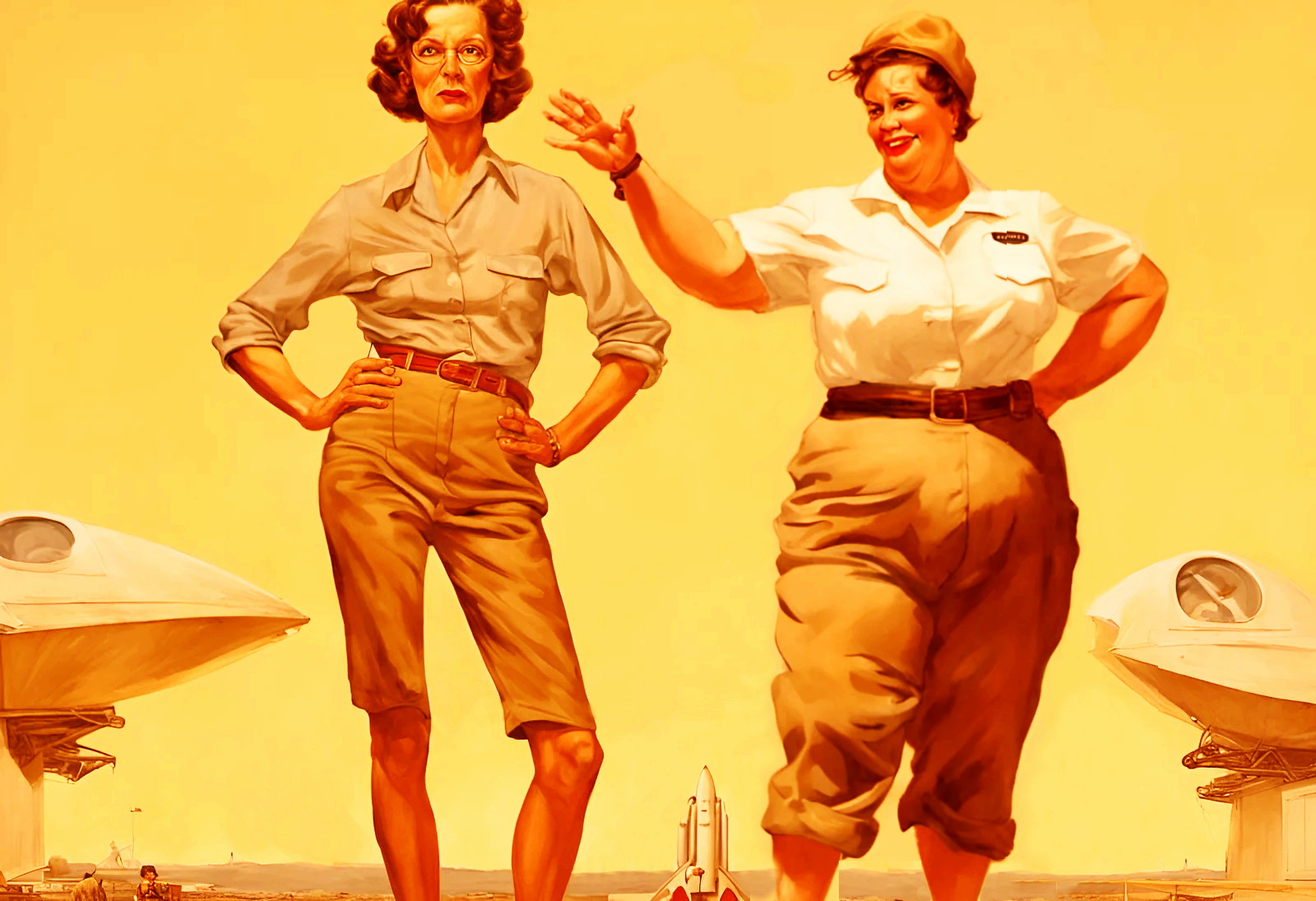
A spaceship arrives carrying two aging, unattractive women who offer themselves as prostitutes. Once again, Lewis’s critics charge him with “misogyny.” Why? Because Lewis supposedly depersonalizes the two women by not giving them names. Lewis labels them “the Thin Woman” and “the Fat Woman.”
The Thin Woman is an intellectual who spouts jargon-laden rationales for the biological necessity of prostitution. The Fat Woman is an aging prostitute who has volunteered to “play doxy” to the sex-starved spacemen on Mars.
The two “ministering angels” of Lewis’s short story, upon their arrival on Mars. (Copyright 2023 by James Denney)
A careless reader might think the story is merely about prostitutes for spacemen. In reality, the story is shown in the closing sentences to be about God’s grace and redemption. The fact that the Thin Woman and the Fat Woman do not have names is beside the point. They are fully human characters. The Fat Woman is especially well-delineated and sympathetic as she tells her story to the Monk.
By the end of the tale, the Monk sees the Fat Woman not as a mere prostitute, but as a child of God, a woman who might take her place in Heaven alongside Mary Magdalene. He realizes that God has sent him on a journey of 40 million miles not for his own spiritual benefit, but that he might become a “ministering angel” to her soul. Far from being an exercise in misogyny, “Ministering Angels” is a story of Christian grace.
A Feminist Ahead of His Time
The most telling proof of Lewis’s advanced views on gender equality can be found in his final novel, Till We Have Faces: A Myth Retold, published in 1956. When he was eighteen, Lewis read Metamorphoses by Apuleius and was captivated by the myth of Psyche, a mortal woman who weds the god Cupid and becomes a goddess. Lewis decided to write his own version, told from the point of view of Psyche’s sister, Orual.
By the early 1920s, Lewis had made several attempts to write the story—but he abandoned each one. In 1955, with the encouragement of Joy Davidman, he made one more attempt. The result was a powerful novel written in a woman’s voice and point of view.
This is a rare achievement. Here is a male writer telling a deeply emotional story from a woman’s first-person perspective—and he writes with skill and sensitivity. The list of male writers who have successfully written in a woman’s voice is pitifully short. Charles Dickens writes in the voice of heroine Esther Summerson in parts of Bleak House. Philip K. Dick’s The Transmigration of Timothy Archer is narrated in first person by a woman, Angel Archer. But neither Dick nor Dickens peers as deeply into the soul of a woman as Lewis does in Till We Have Faces.
Lewis’s warrior queen Orual from Till We Have Faces. (Copyright 2023 by James Denney)
Lewis portrays Orual as a highly intelligent woman who considers herself “ugly.” She is the daughter of a king in a patriarchal society that treats most women as either objects of desire or as slaves. To compensate for her self-image of unattractiveness, Orual trains to outperform men as both a leader and a sword-wielding soldier, breaking gender norms in the process. Through her inner monologue, Lewis explores her tormented feelings and her unfulfilled longings.
Through most of the novel, Orual is the consummate unreliable narrator. Late in the novel, she realizes that the process of writing her story has forced her to see herself clearly—and to understand how wrong she has been about her own life. When she finally submits herself to the gods, she undergoes a conversion that is parallel to a Christian conversion. She is transformed as a human being, as a spiritual being, and as a woman.
Till We Have Faces is a stunning achievement. The novel would not exist if not for Lewis’s profound respect for women as equals. He welcomed advice and encouragement from Joy Davidman, a fellow writer and a forceful, quick-witted debater (he delighted in verbally jousting with her and he eventually married her). When the novel was completed, he asked another woman writer—detective novelist Katherine Farrer—to critique it. He wanted to make sure he had captured a woman’s voice and point of view.
A misogynist could not have pulled off Till We Have Faces. Only a writer with Lewis’s profound respect for women could have written it.
Though Lewis was born in 1898, though his personality was shaped during the antefeminist and antifeminist era of the early 1900s, he emerged as a true feminist writer. In this, as in so many other ways, Lewis was decades ahead of his time.
A few years ago, I was reading an autobiographical book by J. B. Phillips called Ring of Truth. In that book, Phillips recounted a startling conversation between himself and C. S. Lewis, the author of The Chronicles of Narnia. What makes this conversation so remarkable is that Phillips claimed it took place after Lewis’s death.
Phillips began his account of this strange conversation by stating that he was skeptical of all paranormal claims, adding that he was “as unsuperstitious as they come.”[i] Phillips went on to say:
A few days after [Lewis’s] death, while I was watching television, he “appeared” sitting in a chair within a few feet of me, and spoke a few words which were particularly relevant to the difficult circumstances through which I was passing. He was ruddier in complexion than ever, grinning all over his face and, as the old-fashioned saying has it, positively glowing with health. The interesting thing to me was that I had not been thinking about him at all. I was neither alarmed nor surprised. . . .
A week later, this time when I was in bed reading before going to sleep, he appeared again, even more rosily radiant than before, and [he] repeated the same message, which was very important to me at the time.[ii]
In Ring of Truth, Phillips did not elaborate on the matter that was troubling him. But he later related this incident to London journalist Dennis Bardens. Phillips told Bardens he had been dreading the process of dying. It seems that Lewis wanted Phillips to know that, as a Christian, he had nothing to fear from death or even the passage through death.[iii] Lewis’s message to Phillips: “It’s not as hard as you think, you know.”[iv]
I can’t say whether Lewis appeared to J. B. Phillips as a spirit, a hallucination, or a dream. But I trust Phillips’s truthfulness. I’m convinced that he gave an accurate account of his perception of these encounters with Lewis.
This account by J. B. Phillips makes me wish that I, too, could have a personal encounter with C. S. Lewis. I would like to be mentored by Lewis the thinker, Lewis the man of reason and faith, and Lewis the writer. I would like to take my questions to him, spread them out before him, and hear him say, “It’s not as hard as you think, you know.”
Adapted from a photo by The Glucksman Library at the University of Limerick, Ireland. Public domain.
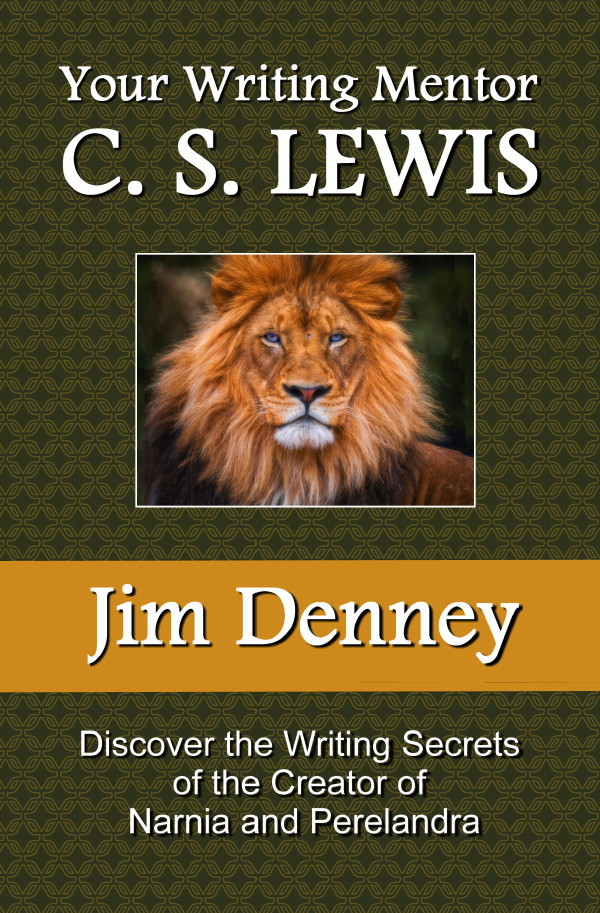
Lewis never wrote a book on writing, yet he did describe his creative process in a number of speeches, essays, and letters to is fans. He has left us a treasury of writing wisdom. I have spent countless hours combing through his writings and the many books and articles written about him. Out of that research I’ve distilled his writerly insights and habits into this new book, Your Writing Mentor C.S. Lewis. In the process of researching and writing the book, I feel I’ve heard him teaching and mentoring me.
C. S. Lewis wrote at least twenty-two nonfiction books, fourteen novels, two science fiction short stories, several collections of essays, and enough letters to fill multiple volumes. He produced all of this literature and these letters while maintaining a full-time career as a professor of English literature, first at Oxford University (Magdalen College, 1925-1954), then at Cambridge University (Magdalene College, 1954-1963). The key to Lewis’s amazing literary output is that he was a “writer in overdrive.” That is, he wrote with amazing speed in a state of unconscious creative flow. In the process, he wrote intuitively and brilliantly.
J. R. R. Tolkien, author of The Hobbit and The Lord of the Rings, once called his friend C. S. Lewis a man of “great generosity and capacity for friendship,” adding:
The unpayable debt that I owe to him was not “influence” as it is ordinarily understood, but sheer encouragement. He was for long my only audience. Only from him did I ever get the idea that my “stuff” could be more than a private hobby. But for his interest and unceasing eagerness for more, I should never have brought The L. of the R. to a conclusion.[v]
It’s true. Tolkien began showing Lewis passages of his sprawling myth of Middle Earth early in their friendship. For years, Lewis was Tolkien’s sole encourager, the only person helping to motivate Tolkien to push his epic tale to completion. If not for Lewis, the world might never have heard of The Lord of the Rings.
On April 15, 1918, the world nearly lost C. S. Lewis. On that day, nineteen-year-old Second Lieutenant Clive Staples Lewis of the Somerset Light Infantry took part in an assault on German positions in the French village of Riez du Vinage. An artillery shell exploded near Lewis, killing one of his close friends and nearly killing Lewis. He carried shrapnel from that shell in his chest for the rest of his life. Had Lewis died that day, there would have been no Screwtape Letters, no Space Trilogy, no Chronicles of Narnia—and probably no Lord of the Rings.
Imagine a world without the writings of C. S. Lewis and J. R. R. Tolkien. Now imagine a world without your ideas, your insights, your stories. The world needs your vision, insight, and imagination. That’s why I wrote Your Writing Mentor C.S. Lewis. My goal in that book is to energize you with the same principles that empowered Lewis and urged Tolkien onward. Here’s the Table of Contents from the book:
1. C. S. Lewis, Writer in Overdrive On Lewis’s amazing ability to write quickly and brilliantly.
2. A Childlike Approach to Writing How to shed the inhibitions and self-defeating habits that hold us back.
3. Keeping Up with Lewis A step-by-step explanation of how to get into “flow” so we can write quickly and freely “in overdrive”—as Lewis did.
4. Why We Write An examination of Lewis’s motivation for writing—and developing our own sense of mission as writers.
5. The Discipline of Writing How to write consistently and productively every day, as Lewis did.
6. The Craft of Writing How to write effectively and brilliantly, as Lewis did.
7. Escapism, Art, or Allegory? Should we write merely to entertain—or should we strive for higher art and deeper meaning?
8. Writing for Children Lewis’s insights into the special needs of young readers.
9. Other Worlds, Other Realities Writing fantasy and science fiction.
10. Five Thousand Words or Less The special rules (which Lewis exemplified) for writing short stories.
In my study of C. S. Lewis, I discovered that he wrote with amazing speed in a state of creative flow. This book will show you how you can write quickly, freely, and brilliantly as Lewis did. So let me introduce you to this wonderful friend I’ve never met—my writing mentor, and yours, C. S. Lewis.
[i] J. B. Phillips, Ring of Truth: A Translator’s Testimony (London: Hodder and Stoughton, 1967), 88.
In the summer of 1932, C. S. Lewis astonished himself.
It had been a busy and stressful year, with a heavy schedule of lecturing, tutoring, and student examinations. Yet Lewis had a book inside him that desperately wanted out—an allegory of his 1931 conversion to the Christian faith. As he told his boyhood friend Arthur Greeves in a July 1932 letter, he hadn’t had time to read a book during the past eighteen-week term, much less write one.
In August, Lewis took a cross-channel boat to Ireland for a two-week visit with Greeves. He arrived at the Greeves family home in Belfast on August 15, and stayed until August 29. He hadn’t planned to write during his visit with Greeves, but somehow, amid the afternoon walks and late-night conversations with his closest friend, something wonderful happened:
Lewis wrote a book.
When he boarded the boat to return to England, he had in his luggage a nearly-complete handwritten draft of what would be his first published novel, The Pilgrim’s Regress. It totaled more than 60,000 words. During those two weeks, he had averaged about 4,300 words per day.
In the fall of 1932, Lewis made revisions and edits. His brother Warren, recently retired from the army, typed up the revised manuscript with a carbon copy. Lewis mailed a copy of The Pilgrim’s Regress to Arthur Greeves, who read it and sent back a list of suggestions. By late January 1933, J. M. Dent & Sons of London, publisher of the Everyman’s Library series, accepted The Pilgrim’s Regress for publication. Upon its release later that year, literary critic Bertrand L. Conway (Catholic World) called it “a caustic, devastating critique of modern philosophy, religion, politics, and art.”
Though it is not Lewis’s best-known or best-loved book, The Pilgrim’s Regress has endured and is widely considered a classic work of philosophical fiction. It’s all the more remarkable that Lewis composed the book in a mere two weeks.
[This excerpt is from Chapter 1: C. S. Lewis, Writer in Overdrive]
To discover how Lewis learned to write quickly—and how you can write quickly and brilliantly as he did—read Your Writing Mentor C. S. Lewis, available now in trade paperback on Amazon.
Images: Bronze sculptures of Aslan (top) and Tumnus the Faun (right) at C. S. Lewis Square in Belfast, a public space commemorating Belfast-born author C. S. Lewis and his creations from the first Narnia novel, The Lion, the Witch and the Wardrobe. Photos by K. Mitch Hodge on Unsplash.
WRITING IN OVERDRIVE – Available on Amazon
Buy Now
I knew I wanted to be a writer when I was about nine years old. How about you? Do you have stories to tell? Would you like to spend your days thinking up adventures and writing them down, like I do? Excellent! Writing is a lot of fun. If you’d like to be a writer, too, then I have some ideas that may help you reach your goals.
Tip #1: Write About What You Really Care About
I’ve heard people say, “Write what you know.” Well, I say, “Write what you really care about.”
The problem with “Write what you know” is that there are a lot of things that are fun to write about that nobody has ever done. For example, my Timebenders books are about time travel—but I’ve never traveled in time. I’ve never been scared out of my socks by a Tyrannosaurus rex. I’ve never been to an old English castle. I’ve never gone to the future and been chased by robots. If I could only write what I know from my own experience, I couldn’t have written Timebenders.
If you write a story about a different time or place, you may need to do some research. For example, if you want to write a story about the American Civil War, you’ll need to read books on American history in the 1860s. One of the most famous novels ever written about the Civil War is The Red Badge of Courage by Stephen Crane. Yet Stephen Crane was never a soldier and was never in the Civil War. He didn’t write what he knew; he did research. And he did his research so well that his book convinced many people that he had actually been a soldier in the war.
So write whatever you really want to write about, whatever you think would make an interesting story, whatever you really care and feel intensely about. Write about the things you love, the things that make you angry, or the things that make you afraid.
Tip #2: Read.
A writer is a reader first of all, so read every day. And when you read, don’t just read your favorite kind of book. Read all kinds of books. Whether you like scary books or fantasy or adventure stories or romance, you should read other kinds of books as well. Read fiction and nonfiction. Read books about the lives of famous people. Read books about science, history, literature, and art. Read poetry. Read the Bible. If you want to be a good writer, become a well-rounded reader.
Tip #3: Write All the Time.
Some people only like to write when they feel “inspired.” But I’ve found that the best way to be inspired is to sit down and start writing—even when I don’t feel like writing. I write every day, and I don’t always feel “inspired” when I begin. But soon after I start writing, ideas and sentences start to flow. I start having fun. And I keep writing for an hour, two hours, or three hours at a stretch.
Keep a journal or diary. Write down observations about interesting events and interesting people. Write down things that happen to you. Write about things that make you feel happy, angry, scared, sad, or embarrassed. Someday, you may use those observations as bits and pieces of a story or book.
When you write, remember it’s okay to imitate writers you admire. I don’t mean you should “steal” story ideas or actual sentences from other writers. But study your favorite writers and see how they create characters, how they write believable dialogue, how they create realistic settings and descriptions, and how they use metaphors to create word pictures in the reader’s mind. It’s okay to study and imitate other writers—that’s how we learn. Over time, you’ll develop your own style and a writing “voice” that is uniquely your own.
Tip #4: Relax and Daydream
My best ideas come when I am relaxed, not when I’m super-concentrating. If you concentrate real hard and tell yourself, “Think. Think. Come up with an idea.,” your imagination will freeze up. But when you relax, you loosen up your mind, you let your thoughts drift, and ideas start to flow.
Here are some relaxation ideas: Step away from your desk or computer for a moment, lie down on the couch or your bed, and just daydream about your story. You can listen to music, but keep the TV, phone, and video games turned off. Take a walk, get some exercise, or do some yardwork—sweeping the patio or raking the leaves in the yard.
As you let your thoughts drift, daydream about the characters in your story. What do they look like? What are their personalities like? How are your characters different from each other? Why do they like or dislike each other? What makes them get mad at each other? What common goals do they have to unite them? Are your characters messy or neat? Are they lazy or hard-working? Are they kind or are they mean? How do they talk? How can you give each character a unique-sounding voice?
Daydream about your setting. How can you describe the setting of your story and make it feel real? Let’s say your story takes place in a garden. As you daydream, ask yourself: What grows in this garden? What plants and flowers do you see? What are the unique smells and sounds in this garden? What kinds of insects and birds do you see and hear in this garden? Help your reader see, smell, and hear the garden. Get inside the skin of your characters and feel what they feel. Let the reader feel it, too: The warm, golden sunshine on a character’s face, or the fragrance of orange blossoms on the breeze. Help your reader to be there, right alongside your characters.
Daydream about your plot. Ask yourself: How can I start the story in an exciting way? What unexpected thing can I do to surprise the reader? What can I do at the end of the chapter to make the reader want to turn the page and keep reading? How can I keep the reader asking, “What happens next?”
Tip #5: Don’t Try to be Perfect.
Don’t try to be perfect when you write. Tell yourself, “It’s okay to write badly. The important thing is to just write.” Get the words down, even if you’re not sure of the spelling, even if you think it’s the worst piece of writing anyone has ever done. That’s okay. Just write. Jodi Picoult, who has written bestselling novels and Wonder Woman comic books, said, “You might not write well every day, but you can always edit a bad page. You can’t edit a blank page.”
I make my living writing books—yet I write badly all the time. And that’s okay. It doesn’t bother me one bit to write badly. You know why? Because it’s just a first draft. First drafts are supposed to be bad. That’s why they call them “first drafts.” I don’t worry about a bad first draft, because I know I’m going to do a second draft, and a third draft, and by the time my third draft is done, it’s going to be a very good piece of writing.
When you write your first draft, write it as fast as you can. Don’t criticize it. Don’t go back over the sentence you just wrote and keep fiddling with it. Write one sentence and move quickly to the next sentence, and keep going, going, going, without looking back. The faster you write, the better you write. When you write quickly, you write with the creative side of your brain; when you write slowly and try to make it perfect, you write with the critical side of your brain.
The best writing is done by the creative side of your brain, because that is writing that flows, that soars, that inspires. Then, after you create your first draft, you let the critical side of your brain go over it, tidy it up, and make it sparkle. Both sides of your brain are important, but when you do your first draft, write it quickly, write it creatively. Don’t let the critical side of your brain interrupt your creative flow.
Tip #6: Welcome Criticism
Never fear criticism. I always have people criticize my books before they’re published, because I want my books to be as good as they can be. If there are mistakes or boring places or dumb ideas in my books, I hope someone helps me catch them before the book is printed.
Remember that writing is a matter of taste—and what one person finds interesting, another person will find dull. So don’t expect to please everybody, and don’t be surprised if you get conflicting advice from different people. That’s okay. Listen to the criticism and see if it makes sense to you. If the advice makes sense, follow it. If the advice doesn’t ring true, ignore it and write it the way it seems best to you.
Show your writing to your friends and teachers. Start a writing club and share your stories with each other. Criticize each other’s stories—not in a mean or hurtful way, but in a helpful way: “I think this dialogue could be improved if you did such and such,” or, “What if your character decided to do this instead of that?” Encourage each other and help each other to do your finest work.













 Writing in Overdrive